This lesson was aimed at Secondary 2 Normal Academic students and the purpose of the lesson was for students to understand what inequality and exploitation were and how they existed in Sing to the Dawn.
In the first part of the lesson, I identified five students and grouped them into Group A and named them "Radollans" while I told the rest of the class that they were all part of the same group known as "Gaverills".
Instructions for the Gaverills were as follows:
Each student was to walk up to me individually and collect 1 sweet then return to his/her seat. Each person will have to repeat this three times.
While the Gaverills were doing this, the Radollans were instructed to sit down, relax and talk to each other. However, when the Gaverills had finished collecting the sweets, the Radollans were instructed to collect 2 out of 3 sweets from each Gaverill. After which, the Radollans were shown 2 huge bags of Twisties and were told that they could exchange their sweets for these Twisties which they were allowed to share only amongst the 5 of them.
After the activity, I asked the Gaverills to explain how they felt and I asked how the Radollans felt. The Gaverills who were representative of the villagers were able to explain that they felt that the activity was unfair and they were unhappy while the Radollans expressed that they were happy because they received more than what they asked for without having to do any work, which was representative of the Landlords.
Based on this activity, I distributed a worksheet and asked the class to identify how this system of injustice and exploitation made the villagers in Sing to the Dawn feel.
Sunday, April 8, 2012

A creative lesson plan: Studying Characterisation through Who Wants To Be A Millionaire
My creative lesson was aimed at a Secondary 2 Normal Academic class. One of the biggest issue with this class is getting them to complete written work. While they enjoy giving their opinions and/or talking about issues in the text, the thought of working on a worksheet bores them and immediately makes them disinterested in the lesson.
For this particular lesson, I decided to try and incorporate the game "Who Wants To Be A Millionaire" into the lesson in a bid to get them to work on their worksheet.
To begin with I got mini whiteboards from Daiso ($2 each!) and divided the kids into groups of four. Once the student formed their groups, I handed out a whiteboard and a marker to each group and briefed students on what to do.
I downloaded the Who Wants To Be A Millionaire game template from the internet and used the same questions from the worksheet to create the game questions. This way the students will be doing the worksheet, just through a more interesting means. However, unlike the worksheet which would have required students to comb through their text (a play entitled 'Reunion Dinner'
) to find quotes associated with a particular characteristic/characteristics associated with a quote, I shortlisted four quotes/characteristics for the students to chose from. This was done to facilitate the playing of the game.
It looked something like this:
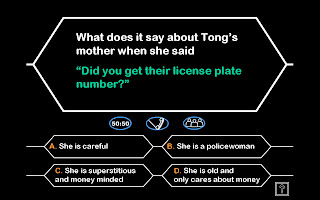
For each question, students are given 1 minute to deliberate with their team mates before they have to write their answer on the whiteboard. When the teacher says "Show me your answers", students will all raise their boards at the same time in order to showcase their answers. Each correct answer is worth 2 points. However, in order to ensure that the students are not just picking answers at random, an extra point is awarded to the group that can explain why a particular answer is the correct answer. This will ensure that students actually discuss and engage with the text, rather than merely point to random answers.
At the end of every question, students are to write down the answers in their worksheet. This ensures that students are still doing their worksheet.
The idea of a competition and allowing students to be doing something in this lesson made them a little more inclined to complete the worksheet.
For this particular lesson, I decided to try and incorporate the game "Who Wants To Be A Millionaire" into the lesson in a bid to get them to work on their worksheet.
To begin with I got mini whiteboards from Daiso ($2 each!) and divided the kids into groups of four. Once the student formed their groups, I handed out a whiteboard and a marker to each group and briefed students on what to do.
I downloaded the Who Wants To Be A Millionaire game template from the internet and used the same questions from the worksheet to create the game questions. This way the students will be doing the worksheet, just through a more interesting means. However, unlike the worksheet which would have required students to comb through their text (a play entitled 'Reunion Dinner'
) to find quotes associated with a particular characteristic/characteristics associated with a quote, I shortlisted four quotes/characteristics for the students to chose from. This was done to facilitate the playing of the game.
It looked something like this:

For each question, students are given 1 minute to deliberate with their team mates before they have to write their answer on the whiteboard. When the teacher says "Show me your answers", students will all raise their boards at the same time in order to showcase their answers. Each correct answer is worth 2 points. However, in order to ensure that the students are not just picking answers at random, an extra point is awarded to the group that can explain why a particular answer is the correct answer. This will ensure that students actually discuss and engage with the text, rather than merely point to random answers.
At the end of every question, students are to write down the answers in their worksheet. This ensures that students are still doing their worksheet.
The idea of a competition and allowing students to be doing something in this lesson made them a little more inclined to complete the worksheet.
Saturday, April 7, 2012
A creative poetry lesson on the poem "The Longest Journey in the World"
This lesson is a continuation of a previous lesson of a study on the poem “The Longest Journey in the World” by Micheal Rosen, found in Rainbow Volume 2 (their literature textbook). The poem talks about this little boy (the speaker) who competes with his brother every night to get ready for bed, as the last one to get ready would have to switch off the lights. This lesson was taught to my sole literature class, a banded class of 21 secondary one students from the normal academic stream in a 40 minute period. The objective of the lesson was for the students to understand the imagery (personification) and the themes that appear in the poem.
I started the activity by getting the students to close the windows and lights to ensure that the room was as dark as possible. Next, I got them to blindfold their eyes with black cloth. I told them that they would have to listen to the sound clip and let me know what they thought the sounds were, why they thought that those sounds were what they thought they were and how they felt as they listened to the sound clip. Thereafter, they had to write their thoughts on the whiteboard. This sparked off a discussion on the idea of imagination and fear of the dark (themes) and attitude of the speaker in the poem.
Next, I distributed worksheets for the students to work in groups of threes and got them to generate responses to a series of questions related to the ideas of imagery and theme. The worksheet was fairly simple and I used mind-maps and a graphic organizer to help them organize their points. Thereafter, the students had to share their responses.
Finally, in the last part of the activity, I returned the students the floor plan of a room. Previously, they had worked on sticking stickers of various objects (objects which appear in the poem eg Bed, Painting, Water Pipe, Light Switch, Pyjamas) on the floor plan of the little boy’s bedroom so that they had an idea why the little boy was so fearful of the journey between the light switch and his bed. The students will draw a new object on a sticker and paste it in the room. They will have to explain the following on their worksheet: i. their choice of object ii. the reason for their choice of the object (how the object would be frightening to the little boy when it comes alive (personified) in the dark.
A Creative Lesson for Sing to the Dawn
This lesson was an extension of the previous lesson whereby my 1NA students focused on identifying social ills in the City in Chapter 4 of Sing to the Dawn. Students were tasked to create a comic using the website: http://www.makebeliefscomix.com/Comix.
Students agreed that it would be logical to expect a conversation between Dawan and her mother as they are walking back home from Noi’s house (when asked, students articulated promptly: “It was three long kilometres!”) even though Kwai comes into the picture after a while. This activity fits in with the dramatization task whereby students are also encouraged to incorporate ‘missing scenes’. Students are to: (1) include at least two negative aspects of the City; (2) demonstrate the likely reactions of Dawan and her mother based on what they have read from Chapters 1 to 4; and (3) help Dawan support her decision to go to the City based on evidence from these chapters. To facilitate students' understanding of the task requirements, there was a modelling process prior to the activity. Having created a script (assigned as a take-home activity in the previous lesson), they were brought to the computer laboratory where they focused on creating the comic.
The website was chosen as there are quite a few characters students could choose to portray Dawan and her mother; each character is presented in four varying appearances along with different gestures; the students had to explain their choices e.g. how they accentuate the characterization (or particular attributes) of Dawan and her mother. It was quite successful; the students generally have short attention span but all of them demonstrated great engagement with the task for the entire period; some even demonstrated great characterization in their comic. The students gave very positive feedback after the lesson and requested to have more of such activities in future.
Creative Lesson: Character Analysis using The Good Earth
Class: Secondary 3 Express (Elective Literature, Set-text)
To analyse the character of O-lan, one of the main characters in the novel, I got my students to first identify her character traits from a list that I had provided. The list also contains some traits that are not applicable to the character. This is to test on their understanding. After a short discussion, the class came up with their own list of character traits for O-lan, using the one that I had as a guide.
Then I divided the class into 4 groups and got each group to choose 2 traits from the list. Based on the traits they have chosen, they were to imagine that they are a group of matchmakers in ancient China and they have to come up with an advertisement, to promote O-lan as the potential wife. They are to use the PEEL structure as a guide on what to include in their presentation. The advertisement cannot be in the form of a poster or a brochure. Basically the students have to act out their advertisement. In order to provide evidence to support their promotion, they have to act out the scenes from the novel that displays the trait of O-lan they are promoting. During each group’s presentation, the other groups who were not presenting will play the role of the ‘single men’ who are looking for a wife and will decide whether they would want O-lan as their wife based on the presenting group’s advertisement. After all of the presentations, there was a need to consolidate all of the points for the students to take away from.
A Creative Lesson Plan for Macbeth
As an introductory lesson to Shakespeare’s Macbeth with my Year 3 students, the students were split into 2 groups of 10 and tasked with performing different versions of a condensed version of Macbeth, “The 32-second Macbeth”, available from the Folger Shakespeare Library. The lesson objectives were to help the pupils understand that plays are written to be performed and that different interpretations of the same play would influence the the way it is performed. To better illustrate this point, the groups were given different interpretations of the cause of Macbeth’s downfall:
1. Macbeth’s downfall was caused by his own greed and ambition.
2. Macbeth’s downfall was manipulated by Fate and the Three Witches, and was therefore inevitable.
Students were tasked with preparing a performance that would clearly illustrate their given interpretations.
As the class is generally vocal and eager to perform, they were engaged in the performance activity. In terms of the effective delivery of their given interpretations however, the quality of work was varied. It was consequently important that a teacher-led class discussion was conducted after their performances to evaluate what was effective or ineffective about the performances and how it could have been improved.
Creative Lesson Plan- The Emily Hunger Games
I did this for my CT lesson observation with Sec 2E3.
As the students have already been exposed to the analysis of Emily's (in Emily of Emerald Hill) character study, this lesson objective was to challenge them to evaluate her character using the context of the movie The Hunger Games.
The students are divided into their drama project groups and tasked to send one "tribute" to the front of the class after 15 minutes of preparation. Their goal is to convince the audience (that is, their classmates) that they are the real EMily. Each group is assigned one personality trait-domineering, efficient for example. They have to use the PEE structure to act out the entire 1-2 minute presentation.
The role of the audience was to write down in their handouts what was presented by each of the Emilys and they had to come to a vote. The losers are those who failed to make use of the PEE structure to convince them that they are the real identity of Emily.
I aired the trailer at the beginning of class and after that, role played as Effie Trinket, the woman who picked the names of the main characters. It was interactive and really fun as the students got to use something that they already know and are excited about, and apply it to something that is a little more complicated.
Subscribe to:
Posts (Atom)